


'The Deep Work Hypothesis and its Limitations' deepwork productivity
“professional activities performed in a state of distraction-free concentration that push your cognitive capabilities to their limit. These efforts create new value, improve your skill, and are hard to replicate.
non-cognitively demanding, logistical-style tasks, often performed while distracted. These efforts tend to not create new value in the world and are easy to replicate. ” Examples of shallow work are time spent on social media applications, data entry, replying to emails, etc. Unfortunately, shallow work tends to quickly fill a day, as we all know too well the siren song of the little tasks and interruptions that creep and must be attended to right away. When our focus is fragmented between social media, emails, Internet news, texting, it is becoming harder to access pockets of uninterrupted time to find flow. Flow is a term coined by psychologistwe feel a perfect match between skill and challenge, a loss of consciousness, and we experience timelessness in the flow statewhen we are involved in it, we feel that we are living more fully than during the rest of life.Deep work is an activity well suited to generate a flow stateInterruptions or distractions, which sometimes are unavoidable, pull us from a flow state to more mundane tasks. Unfortunately, these interruptions have a “stickiness” or, more scientifically put, “attention residue” . And so, it becomes increasingly difficult to switch from shallow work to deep work.s we shift to an information economy, more and more of our population are knowledge workers, and deep work is becoming a key currency — even if most haven’t yet recognized this reality. Though an increasing number of people will lose in this new economy as their skill becomes automat or easily outsourced, there are others who will not only survive, but thrive—becoming more valued than before. But how deep work would lead to thriving? Newport identified two abilities for thriving: the ability to master hard things and the ability to produce at an elite level in terms of both quality and speed. To master these abilities, Newport proposes a few deep work philosophies.is the most focused form of deep work as it involves spending almost all working hours on deep work and minimizing all other types of work. Obviously, this style is not realistic for most of us who must do some context switching in our work. This philosophy attempts to maximize deep efforts by eliminating or radically minimizing shallow obligations. Practitioners of the monastic philosophy tend to have a well-defined and highly valued professional goal that they’re pursuing, and the bulk of their professional success comes from doing this one thing exceptionally well.My full-time writing schedule means that I have to be pretty much a hermit. The only way to gain enough efficiency to complete The Art of Computer Programming is to operate in batch mode, concentrating intensively and uninterruptedly on one subject at a time, rather than swapping a number of topics in and out of my head. I’m unable to schedule appointments with visitors, travel to conferences or accept speaking engagements, or undertake any new responsibilities of any kind.I have been a happy man ever since January 1, 1990, when I no longer had an email address. I’d used email since about 1975, and it seems to me that 15 years of email is plenty for one lifetime. Email is a wonderful thing for people whose role in life is to be on top of things. But not for me; my role is to be on the bottom of things. What I do takes long hours of studying and uninterruptible concentration. I try to learn certain areas of computer science exhaustively; then I try to digest that knowledge into a form that is accessible to people who don’t have time for such study. On the other hand, I need to communicate with thousands of people all over the world as I write my books. I also want to be responsive to the people who read those books and have questions or comments. My goal is to do this communication efficiently, in batch mode — like, one day every six months. So if you want to write to me about any topic, please use good ol’ snail mail and send a letter to the following address…allows for a high amount of deep work to be obtained by arranging a year, months or weeks, into chunks of deep and shallow work. This philosophy asks that you divide your time, dedicating some clearly defined stretches to deep pursuits and leaving the rest open to everything else.. Here, Jung would reflect on his works or writing with little interruption., a business school professor and writer, who stacks his courses into one semester and focuses on deep work the following semester. During “deep” semesters, Grant would shut his door or put out-of-office auto-responders to his email so that he could work on his research with no interruption. Outside of these deep sessions, he would be open and accessible to others.is an ideal strategy for those with a reasonably static work schedule. If we know in advance our working schedule, we can block hours for deep work with breaks for shallow work, thus obtaining a daily “rhythm”. [The rhythmic philosophy] argues that the easiest way to consistently start deep work sessions is to transform them into a simple regular habit. Newport gives the example of a PhD student, married and a new father, who would wake up before 5:30 AM to have a few hours of uninterrupted writing for his PhD thesis.is a technique to practice deep work sporadically, for when schedules are not static but hectic. The name derives from some journalists’ ability to quickly switch from shallow work to deep, intense, focused mode. Journalists would have slots of only a few minutes between interviews and writing, so they would have to enter deep mode quickly.This strategy is not recommended for beginners as it requires immense mental concentration to switch at will from shallow work to deep work. Newport describes the routine of journalist and author Walter Isaacson: It was always amazing … he could retreat up to the bedroom for a while, when the rest of us were chilling on the patio or whatever, to work on his book … he’d go up for twenty minutes or an hour, we’d hear the typewriter pounding, then he’d come down as relaxed as the rest of us … the work never seemed to faze him, he just happily went up to work when he had the spare time. Naturally, we need to examine our schedules, experiment and determine which option would suit us best. As the realities of the COVID-19 pandemic showed, the lines between work-time and home-time are blurred. We had to bend our rules and adjust our time blocking to make sure children were fed, understood their school assignments, and that we managed to keep up with our daily jobs. A challenge that sent us from most probably rhythmic philosophy to journalistic philosophy ., and I would highly recommend reading it. In a nutshell, the rules for deep work are:Keep a compelling scoreboard . Newport presents “the chain method” attributed to comedian Jerry Seinfeld as an example. In this method, a calendar is kept on the wall, and we mark with an X the day where we did our deep work. After a few days, we would have a chain.
Canada Latest News, Canada Headlines
Similar News:You can also read news stories similar to this one that we have collected from other news sources.
 Teddiursa: A Deep Dive into Pokemon’s Most Important Bear | HackerNoonTeddiursa debuted in Pokemon Gold & Silver, but has since become a background character. Here's why the bear Pokemon is important.
Read more »
 Pristine coral reef discovered in deep water off the coast of TahitiA spectacular coral reef has been found between 35 and 70 metres below sea level near Tahiti, and it seems to be in good health despite the global biodiversity crisis
Read more »
 'Deep structural issues': New report calls for appraisal industry reform, blasts lack of diversityA new study featuring reporting from ABC7 News calls for sweeping reforms to the appraisal industry and scrutinizes the lack of diversity in the profession.
Read more »
 'Magical' massive coral reef discovered deep below surface in Tahiti 'twilight zone'Humans and climate change are killing the world's reefs. The latest discovery of one of the largest deepwater reefs offers hope they can survive.
Read more »
 Plumber offers advice to avoid frozen pipes during deep freezeFreezing temperatures often lead to frozen pipes in homes, and with single-digit lows in the forecast for about a week, plumbers expect to be busy.
Read more »
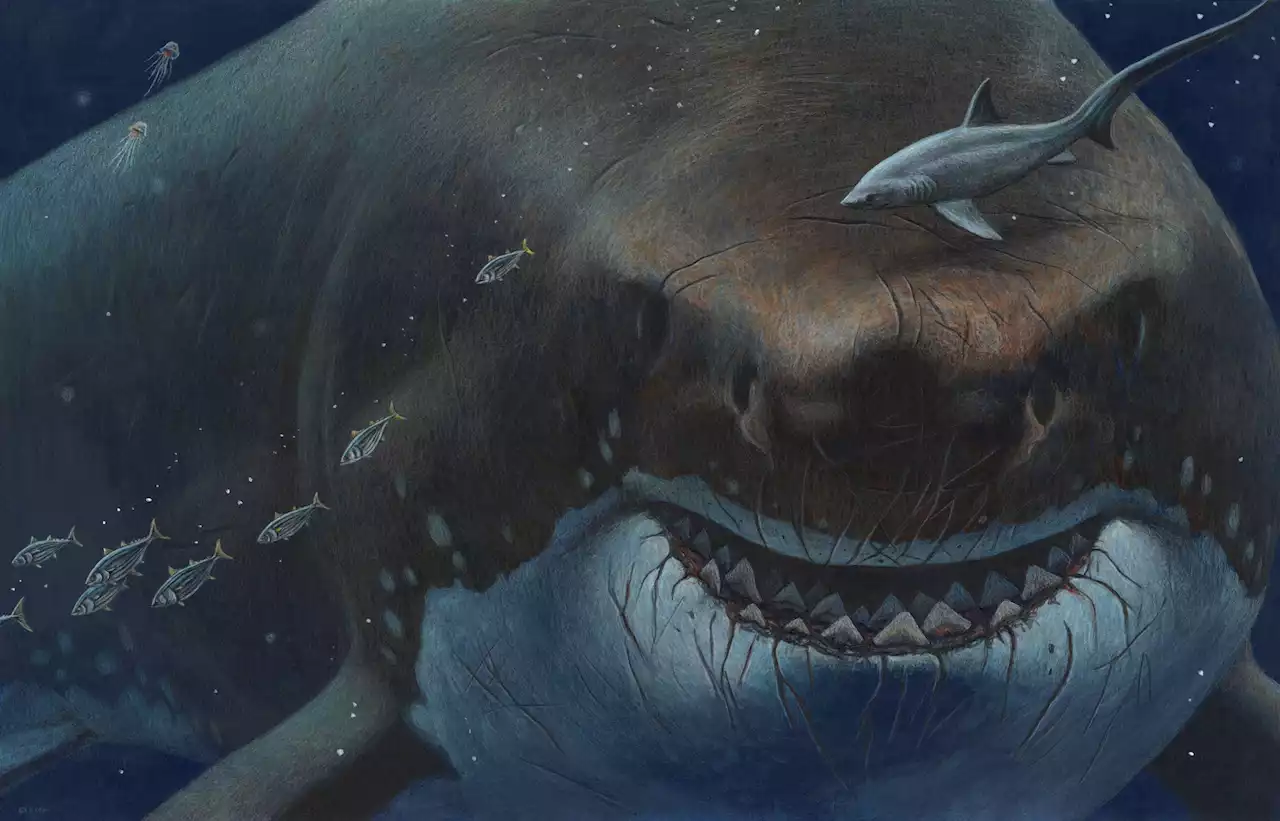 Could an ancient megashark still lurk in the deep seas?If the megalodon were living in the dark, inky depths, it would have had to become a very different sort of creature—one we might not find nearly as cinematic.
Read more »