


SINGAPORE: During the trial of a man accused of raping his mother, his lawyer suggested that the woman 'could have easily avoided' the assault if she had just crossed her legs and 'shut the gates'.
Back in March 2024, Education Minister Fadhlina Sidek announced that primary school students will be taught the basics of AI starting from 2027. — Image by freepik FOR children in the digital age, learning about artificial intelligence in the not too distant future may be as easy as 1-2-3.
In Malaysia, plans are underway for schools to introduce AI into the learning curriculum. Back in March 2024, Education Minister Fadhlina Sidek announced that primary school students will be taught the basics of AI starting from 2027. “Pupils will be introduced to AI basics in the primary school level in the new technology and digital subject. Further exploration and application of AI will continue in the same subject in secondary school, as well as in the computer science, information and communications technology, and design and technology subjects,” she said in a local report. In April this year, Fadhlina said the ministry aims to equip 10,000 schools nationwide with smartboards by 2027 as part of an effort to prepare schools for the new curriculum roll-out. She believes that smartboards can help to promote more interactive learning as well as boosting digital skills among students. In the same month, the minister also shared that selected pilot schools are using AI-powered platforms with features to “identify early risks of dropout and offer customised remediation”. Prime Minister Datuk Seri Anwar Ibrahim has expressed hopes for digital technology and AI to be taught in schools, adding that it’s crucial for the younger generation to start mastering future technologies from a primary level. “These are the technologies of the future. To succeed, you must master them. That is why our universities now have AI faculties, every university has an AI unit and department, and it cuts across all disciplines. I also hope schools move quickly,” he said during an event on April 25.Schools around the world are also putting plans into motion for artificial intelligence to be a part of the classroom learning experience. Just two months ago, the United Arab Emirates announced plans to introduce AI into the public school curriculum this year. Bloomberg reported that students from kindergarten age to the 12th grade will learn about AI from a course that includes subjects on ethical awareness, foundational concepts and real-world applications. UAE daily The National reported that the AI curriculum will expose students to lessons that include designing their own AI systems and understanding command engineering with real-world scenarios. On X, UAE Prime Minister Mohammed Rashid Al Maktoum said the initiative is part of the country’s long-term plan to prepare its young people with advanced skills for the future. “Our goal is to teach our children a deep understanding of AI from a technical perspective, while also fostering their awareness of the ethics of this new technology, enhancing their understanding of its data, algorithms, applications, risks, and its connection to society and life,” he added in a post on X on May 4. Meanwhile in Indonesia, AI and coding will reportedly be introduced as elective subjects for public schools in the country starting this year. Primary and Secondary Education Minister Abdul Mu’ti said in a June 12 report that more than 50,000 schools are prepared to roll out the new subjects. He added that teachers have undergone training to deliver these subjects and the initiative is supported by academic guidelines and defined learning outcomes for students. In China, AI courses and teaching methods will be introduced into the primary and secondary school curriculum starting September. Channel News Asia cited a statement by Chinese education authorities that schools must provide at least eight hours of AI education in a year, either as standalone courses or as part of existing curriculum, such as in IT or science classes. The authorities also said that schools will incorporate AI into after-school activities, club activities and research. A Xinhua report further stated that primary school students will be introduced to AI concepts before advancing to the application of AI in learning and daily life at junior high school level. At the senior high school level, practical courses will be offered to enhance their understanding of AI application and innovation. In a separate statement, China’s Ministry of Education announced the launch of a specialised AI training session for middle and primary school principals and education officials across the country. Education Minister Huai Jinpeng said there is a need to embrace AI as a “transformative force” in education and harness its potential in enhancing the quality and accessibility of learning. He also highlighted the need to promote the use of digital platforms for AI-enabled educational development while ensuring the ethical and safe use of AI, particularly among younger students. Meanwhile, Estonia has announced that 20,000 high school students will have free access to AI-learning tools from September as part of the country’s AI Leap initiative. The government has begun talks with OpenAI and Anthropic to widen the access of AI tools for students in the country.reported that the government is also looking into providing free laptops for students as a possible measure to address the digital divide. Education Minister Kristina Kallas said with generative AI models advancing in capabilities, exercises such as writing essays have become unnecessary. Instead, she said the focus of an AI education should be on helping students to develop critical thinking skills and evaluating the outputs of AI models. Not wanting to be left out, US President Donald Trump signed an executive order on April 23 to look into measures focusing on bringing AI into the K-12 schools – kindergarten, primary and secondary levels – to teach foundational AI literacy and critical thinking skills. The order establishes the White House Task Force on AI Education which aims to develop a ‘Presidential AI Challenge’ to highlight and encourage the use of AI in the classroom. It will also be responsible for creating partnerships to provide AI education resources in schools.reported that Trump said the executive order is a big deal because “AI seems to be where it’s at” before he signed the order in the Oval Office. It also stated that the order comes as US politicians have expressed concerns over American students falling behind other nations, particularly China as technology advances and becomes a major component of the workforce.report noted that Trump-appointed Secretary of Education Linda McMahon has mistakenly confused AI with A1, a popular steak sauce brand in the US. While speaking at a summit on April 8, McMahon said first graders should have access to “A1 teaching”.However, experts have also urged for a more careful approach to AI in education. The Association of Internet-of-Things Malaysia treasurer Pathmanathan Muniandy told Bernama that the subject of artificial intelligence at the primary school level should be introduced in a measured and systematic manner so as not to risk becoming a burden on the existing academic syllabus. “If AI is introduced too early without proper guidance, it may lead to wastage and over-reliance. When used effectively, AI can inspire creativity and innovation at a young age,” he said. He added there is no need to create a new syllabus just on AI when it could be integrated into existing subjects like Maths and Science. “AI education can be incorporated by focusing on safe usage, ethics and understanding both the capabilities and limitations of this technology,” he said. Similarly, digital transformation researcher at Gadjah Mada University Iradat Wirid told Kompas that the Indonesian government shouldn’t rush into new AI-driven education initiatives just to appear on trend. Instead, he said that students should first be equipped with logic, ethics and digital literacy skills.Microsoft alerts businesses, governments to server software attackIndia's financial crime fighting agency summons Google, Meta executives, sources sayOpinion: The human brain doesn’t learn, think or recall like an AI. Embrace the difference
Education Children Technology Computer
Canada Latest News, Canada Headlines
Similar News:You can also read news stories similar to this one that we have collected from other news sources.
 Man dies after collapsing during National Day Parade rehearsal in SingaporeSINGAPORE, June 21 — A 47-year-old man from Changi Airport Group’s (CAG) Parade and Ceremony contingent died after collapsing during a National Day Parade (NDP) rehearsal at...
Read more »
 Tsutomu Ogura steps down as Singapore Lions coach for personal reasonsSINGAPORE, June 25 — Tsutomu Ogura has stepped down as head coach of the Singapore national team for personal reasons, the Football Association of Singapore (FAS) announced...
Read more »
 Tank collides into traffic light during Singapore's National Day Parade preview showFor nearly 20 years, Hiroshima art students have painted hibakusha - atom bomb survivor - stories from firsthand interviews
Read more »
 Singapore home minister: Smaller countries must develop deeper relationships with China, US, EuropeSINGAPORE, July 9 — In a multipolar world, small countries like Singapore have to develop even deeper relationships with other nations, Singapore’s Home Affairs Minister K...
Read more »
 Singapore unveils grant worth S$100,000 each to help SMEs brace for US tariff fallout, larger support pledged for exportersSINGAPORE, July 10 — Singapore is set to launch a new grant by October 2025 to help businesses adapt to the new tariff environment, the Singapore Economic Resilience Taskforce...
Read more »
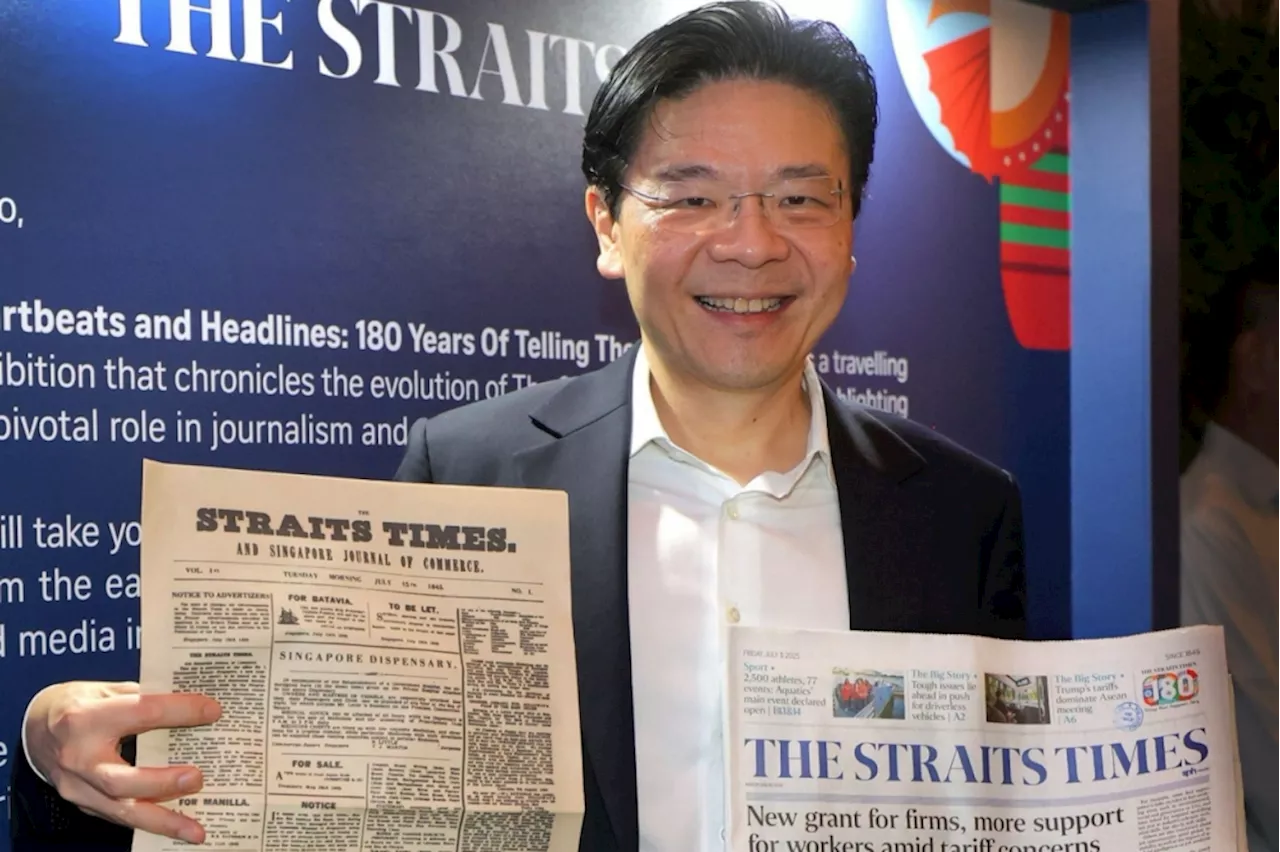 Singapore PM warns against billionaire-owned media, calls for trusted journalism amid digital echo chambersSINGAPORE, July 12 — Singapore’s Prime Minister Lawrence Wong has reportedly touted the critical role of trusted media in helping Singapore navigate an increasingly complex and...
Read more »